How this came about
Before the argument, a note on origins. This is the blog post that introduced the talk and the paper, written in May 2011.
Thanks to the generous recommendation by Zaid Ali Alsagoff, George Siemens invited me to give a talk to the Connectivism 2011 MOOC. I decided that instead of giving a talk about something I know and have thought a lot about — like open access or OER — I would try to challenge myself by proposing a topic that I was in the middle of grappling with, where I really didn't know where I was going or what my conclusion would be. It's quite scary to be giving a presentation on something so "raw" in your mind, but I figured the CCK11 crowd was the perfect crowd for it, and the preparation of the slides helped me really gather my thoughts.
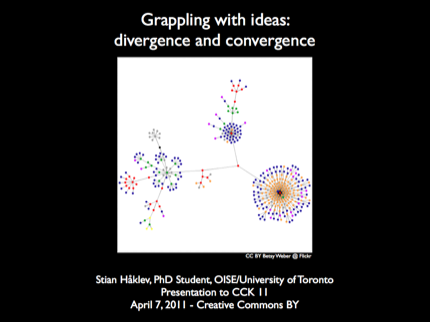
I have thought a lot about how we think and work with ideas — individually, in small groups online, in face-to-face workshops, and in distributed networks. There seemed to me to be something fundamentally similar between approaches to mind-mapping and note taking, collaborative discourse tools like Knowledge Forum and Compendium, innovative workshop methodologies like unconferences and Open Space, and visualizations of massive amounts of networked data. Yet whenever I read about one of these dimensions, they never seem to mention the others. So I tried to map out some of the overlapping areas, and the principles that seem to apply across them.
I later wrote a paper for a course where I tried to push these ideas further. This page weaves the talk and the paper together into a single reading — visual walkthrough and conceptual argument side by side.
Three doors into the same room
Each of the following examples comes from my own experience. Held next to each other, they began to look less like three different things and more like three versions of one problem — how do we get ideas out of our heads and do something useful with them?
We are currently living in a knowledge society, and an ever-increasing part of the workforce is constituted of "knowledge workers" — how well we can work with ideas is becoming more and more crucial to a nation's competitive advantage. In this piece, I examine innovative ways of working with ideas in three different settings, or at three different levels: individually working with ideas, collaborative group learning in an online/hybrid course, and workshop methodology in a physical meeting. There is a copious literature both about individually working with ideas and about group collaborative learning (far less about workshop methodologies), but these theories rarely intersect, or even acknowledge other possible levels.
Setting one: a graduate student buried in highlights
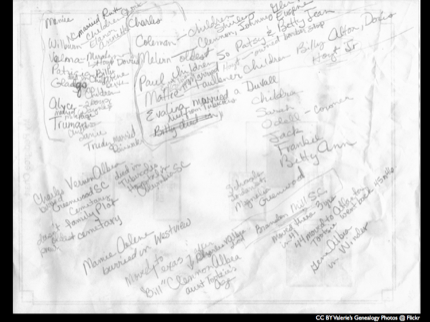
I have been a student for eight years, working with ideas and information. As a student, you process a large amount of input — lectures, readings — and somehow need to capture the most important information, engage with the ideas contained within, and produce the many artifacts that school requests: presentations, papers, projects. As I progress through higher education, the amount of input increases alongside rising expectations for synthesis, critique, and creativity.
Scholars have always had to grapple with "information overload". Blair (2010) writes about how scholars in the Middle Ages used tools such as "commonplace books" to collect quotes and excerpts, and how there was a large industry producing printed books of excerpts. However, the rate has increased rapidly — a simple Google Scholar search gives you full-text access to thousands of nominally relevant papers. My own exploration of this space was partly prompted by my experience using a Kindle to read the academic literature.
The Kindle lets you quickly highlight passages; these are stored in a text file you can manipulate on a computer. After a few months of intensive use, I had more than 900 "snippets" from books and articles I had read. I wanted a way of storing and visualizing them that would help me draw connections, and engage in deeper thinking around specific topics.
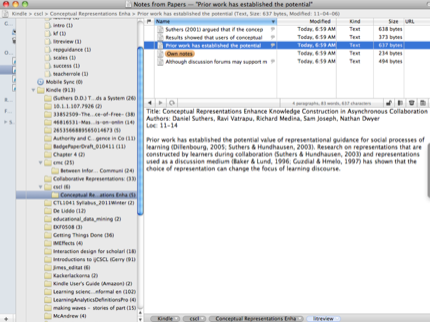
I've written a program that takes all the highlights from my Kindle files and imports them into DevonThink. I can go through them quickly, tag them, find things. What kind of system can help me organize, think, see connections between these snippets?
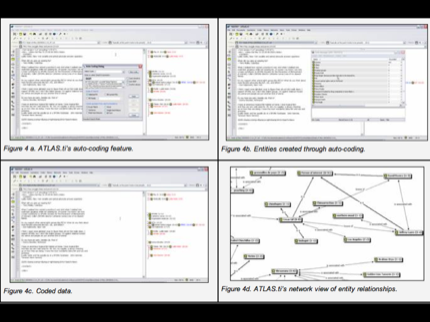
Qualitative researchers face a similar thing. Lots of raw material — interview transcripts, field notes — you're trying to make sense of it. With grounded theory you don't know what your questions or theories will be initially; you start iteratively going through the material, tagging, watching things emerge.
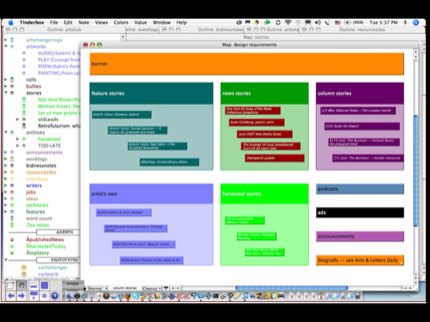
And there's software purpose-built for this kind of thinking. Tinderbox: very complex (which puts some people off), but with strong facilities for expressing information visually, spatially, semantically — outlines, containers, scripts. The person who wrote it also wrote a book about it.
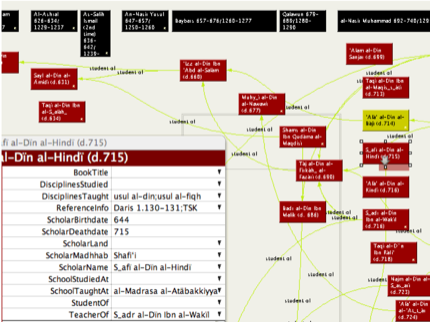
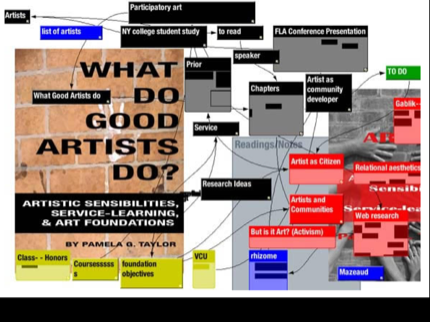
Setting two: a workshop in Zagreb
In 2007, I attended the Open Translation Tools workshop in Zagreb, organized by Allen Gunn at Aspiration Tech. His vision, funded by the Open Society Institute, was to bring together two groups: people working on open-source translation and linguistic tools, and people working on projects that needed collaborative translation. The goal was for each group to leave with a much better understanding of the other, and for us collectively to produce deliverables — a map of existing software, a list of case studies, a report on the key issues facing the field.
Apart from the specific deliverables, an overarching goal was for strong social bonds to form between participants, and for the workshop to be run in a participatory, collaborative, engaging way — where everyone had a chance to explore their own interests and share their own experiences in a democratic fashion.
The methodology is inspired by unconferences — a response to massive conferences where people present on what they submitted perhaps half a year earlier, with almost all conversation going in one direction, no flexibility for emergent ideas. At an unconference, there is no set program; people who show up add ideas for sessions to a large poster, and all sessions are discussion-based. But while the unconference format adds excitement and space for emergence, it isn't quite suitable for workshops that want to get somewhere: for unconferences, the social interactions and open idea-exchange are a sufficient goal in themselves. This is where Gunn's methodology shines.
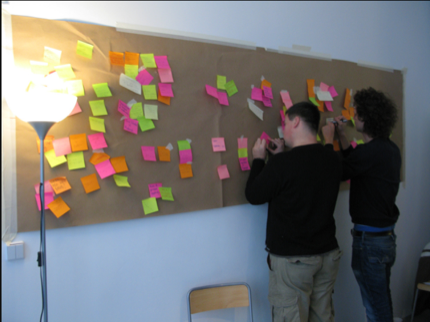
A workshop begins by creating the agenda. Everyone is asked to come up with as many ideas as possible about what we are going to discuss during the next few days, writing each individual idea on a sticky-note — more than a word, less than a paragraph (typically a statement or a question). All these sticky-notes (the more, the better) are glued onto a large canvas of butcher-paper covering an entire wall. Since everyone is working in parallel — sometimes in groups of three, to help build on each others' creativity — this goes very quickly. In ten minutes you can generate hundreds of ideas. Then all ten to twenty participants go to the front and group them: finding sticky-notes that are similar, moving them together. In the end, you have a number of clusters (and perhaps some outliers). The first session ends with naming the different groups. These groups constitute the agenda for the workshop.
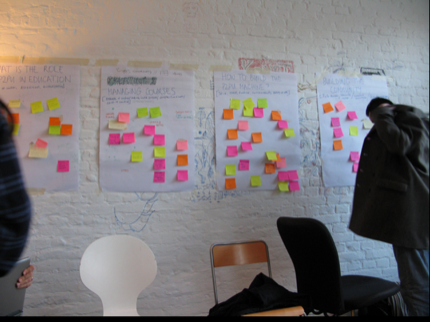
When the groups come back after a break, the facilitator has come up with a number of sessions running in parallel (small groups are more effective and give each person more time to talk and listen). Participants take their sticky notes with them, and are asked to come back with either some key findings to reflect on, or a suggestion of future specific sessions.
Setting three: Scardamalia's Knowledge Forum course
One of the first courses I ever took at OISE was Marlene Scardamalia's "Knowledge Building for a Knowledge Society", taught using Knowledge Forum — a spatially-organized system for collaborative discourse (Scardamalia 2003). At the time, I had no background in education in general, or educational technology in particular, and this course was different from anything I had ever experienced.
We met for two hours each week, and between classes we spent time individually adding content to the Knowledge Forum database. Scardamalia did not lecture during the two hours we had together — at first she introduced key concepts and the software, then we discussed the weekly topics loosely. Most of the learning happened asynchronously, in the database.
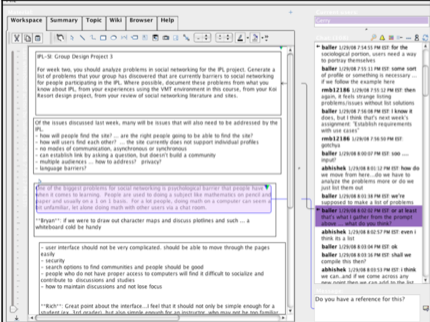
Let me walk you through it, because most people haven't seen it. Knowledge Forum is not open source or available online, so there's a whole world of ideas here that lives behind a paywall. (These next slides are from a screencast I made.)
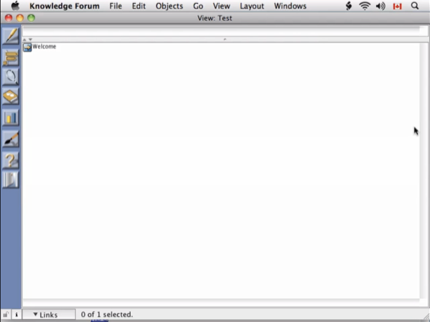
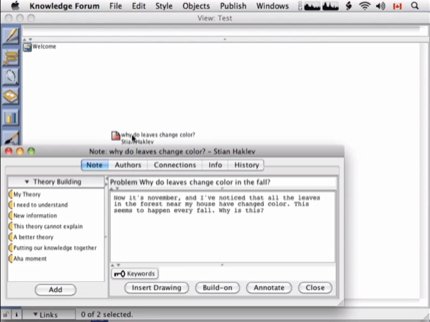
It's a graphical interface, not threaded. Here I'm pretending to be a primary-school student. You write what your problem is; on the left are these scaffolds — you click one, and it inserts the snippet into your text: "I need to understand", "This doesn't explain", etc. It nudges you to think about what kind of statement you're making, what cognitive role you're playing in the discussion. Proven very useful for helping young students be more aware of what they're saying.
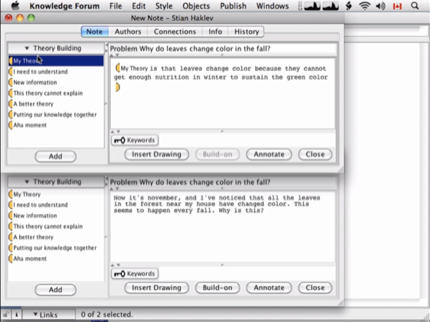
You create a note, and someone builds on it — "I disagree", "here is some new information".
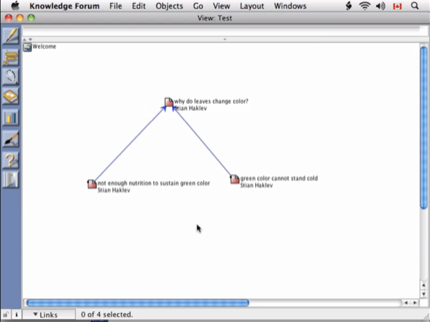
You can organize notes any way you want, spatially.
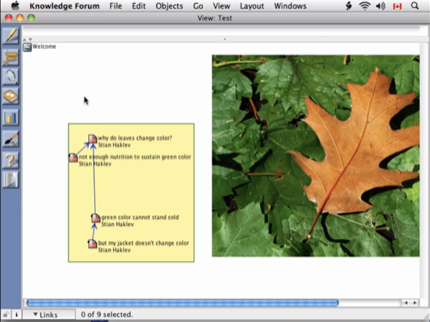
You can even add background graphics.
The course was organized around a draft manuscript Scardamalia and Bereiter were writing about a Knowledge Building Society; initially we spent each week reading chunks of text and adding our ideas using build-upon and scaffolds. Already at this stage, I saw how Knowledge Forum let us carry out many discussions at once, without losing track, or having some discussions dominate while others got bypassed.
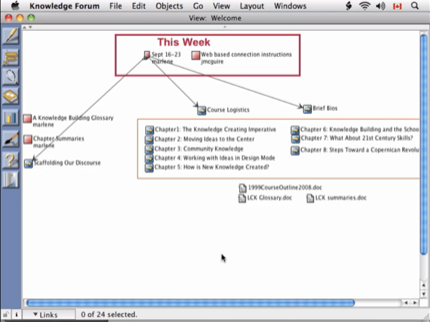
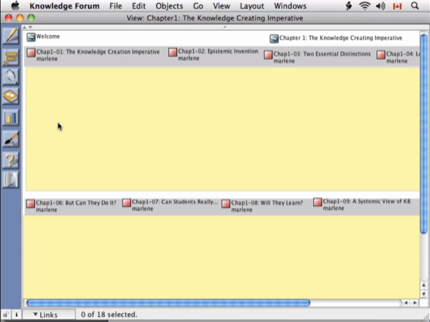
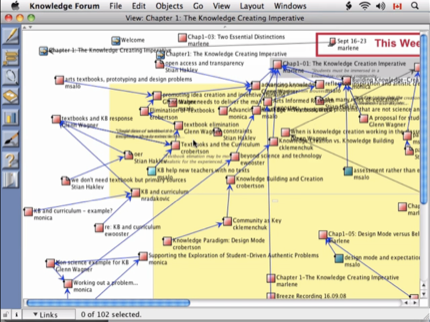
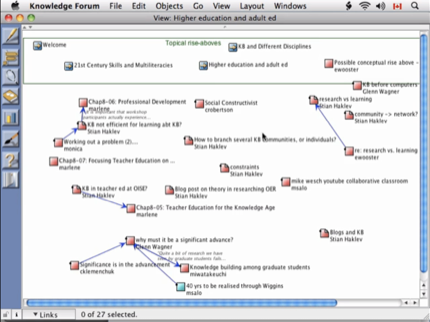
But the real power became apparent around week four or five. Some students suggested that once we had finished reading the manuscript, we step back and reorganize our notes according to topics. We all had the power to create new views, and we were now able to pursue what had been our initial interests coming into the course, as well as recognize emerging themes that nobody had expected to see. By going back through the previous weeks and copying relevant notes to the new topical views, we were able to get an overview of our collective state of knowledge about, for example, Knowledge Building in higher education, or Knowledge Building and assessment. Seeing the notes next to each other, we could identify gaps, and keep probing deeper.
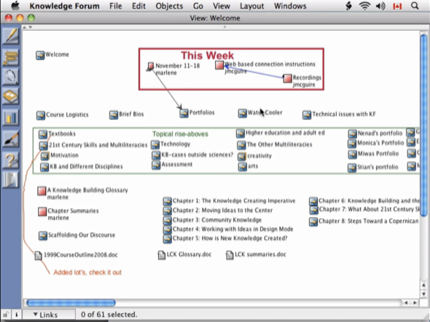
Towards the end of the class, the teacher also had us do personal portfolios. We looked at what key issues I had personally engaged with, what my contributions to the group were. It's a very nice take-away — a representation of my learning from the course. You could invite someone in and say: this is what we've been doing for the last 12 weeks.
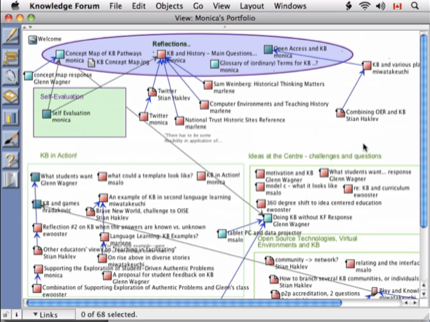
Three settings. Three scales. But when I line them up, the same moves keep showing up: externalize onto a shared surface; generate freely; step back and cluster; name what emerged; dig deeper into a named cluster; move things around; keep going. Let me look at the two concepts I think are doing most of the work here.
Externalization
Get the ideas out of your head. This is the step that all three settings share, and it does more work than it seems to.
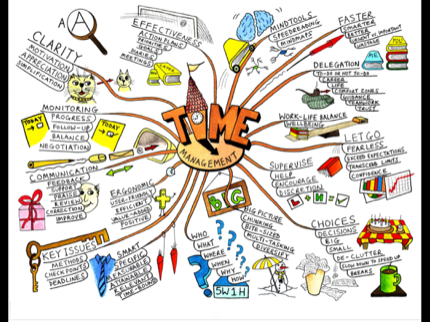
The first step when we are grappling with ideas is to get those ideas out of our minds and down on paper. According to Buzan and Buzan (2006), putting ideas down on paper helps you realize what you know, draw connections, and propel your thinking forwards. That sounds simple. It hides several distinct moves.
Formulating an idea
The very act of having to formulate an idea is helpful in itself, because we have to take something that is a fuzzy representation of associations and concepts in our mind and choose explicit words, or graphics, to represent it on paper or on screen. If we are jotting, we also have to choose where on the page we place each idea, which font and weight we write it in. All of this aids us in exploring relationships and hierarchies between our ideas.
Getting around working-memory constraints
It is only possible for us to mentally hold and manipulate a small number of items at a time. Together with the lack of a clearly formulated idea, this is why we sometimes mull over a problem for a long time and still feel we are not getting any closer. Getting the ideas out on a piece of paper, or in a note-taking software, is a great first step to increasing your capacity to deal with them. The next step is categorization and hierarchy. You start seeing patterns; you begin to organize. A hundred similar ideas listed next to each other are also very difficult to deal with — but if you move four of them into a cluster and name that cluster, it now takes one location in your short-term memory, not four.
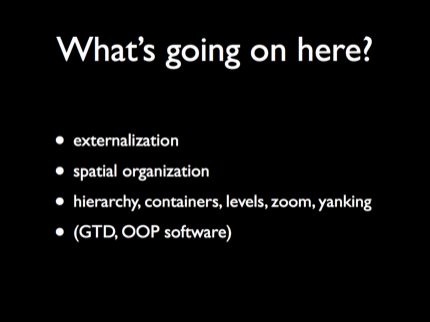
Tinderbox (Bernstein 2007) has a concept called yanking, where you temporarily make a sub-topic in the outline fill the whole screen, becoming the top or central node for a while. The fact that all of your ideas are "safely stored" on the page means you can free yourself from the burden of having to remember them all. You can focus all of your energy on a small part of the idea map, confident that the rest will be there when you return.
The social benefit of trusting that ideas are being taken care of
The trust that the system, and the facilitator, will take good care of your ideas — that your contribution will be properly dealt with — is also a key social concept, in both the workshop methodology and a Knowledge Forum class. It does a lot to create a more positive, open, and engaging audience. At a workshop, if you have expressed your ideas during the initial brainstorming session, and had that become part of a named category, then you know that your idea is "safe", and that it will be dealt with, and given sufficient time, before the workshop is over.
Safe in that knowledge, you can put away the attitude so common in traditional meetings — where everyone is jostling to have their point discussed, and because of this focus on their own ideas, is not open enough to listen to other people's. Likewise, in a Knowledge Forum class compared to a face-to-face seminar or a traditional threaded forum, students stop rushing to get a point across before the topic changes. With KF, multiple different threads of conversation can be maintained at the same time, with none of them drowning any of the others out.
Spatial organization and salience
How you organize notes will impact the way you think. Buzan and Buzan (2006) suggest that the two key factors in memory retention are association and emphasis — both of which are lacking in linear lecture notes. Given that our brains tend to look for patterns and completion, structured, spatially-organized, and linked notes can be a very powerful tool for thought, whereas in traditional notes, the important key concepts drown in a torrent of text.
Suthers (2001; 2008) has developed this into a theoretical framework for analyzing how the design and features of a collaborative tool shape the direction of the discourse, and the outcome of the learning interaction.
Suthers did a series of very interesting experiments. He had two students come into his lab, sitting facing each other looking at individual computers. He'd give one person half of the necessary information, and the other person the other half, and only allow them to use the computer to communicate. Later he'd analyze the quality of the finished product, and also call them back after a week to measure recall.
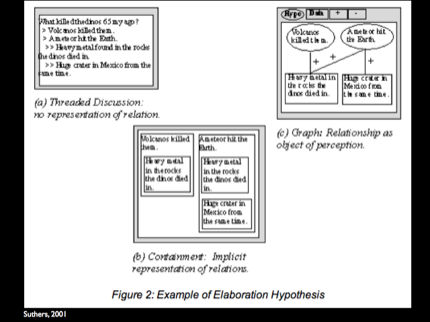
The two key terms Suthers came up with to analyze differences in design were salience and constraints. A torrent of text has no salient features and no constraints. You can write about anything, but nothing stands out — none of the features of the knowledge is more visible than any other. As opposed to pure text, Suthers had students use a spreadsheet where boxes were labelled "evidence", "counter-evidence", "hypothesis", and so on. Students were eager to fill out the empty boxes — which "forced" them to think about what their theory was, what the consequences of it would be, etc. They thought in a much more systematic fashion than they would have with pure text.
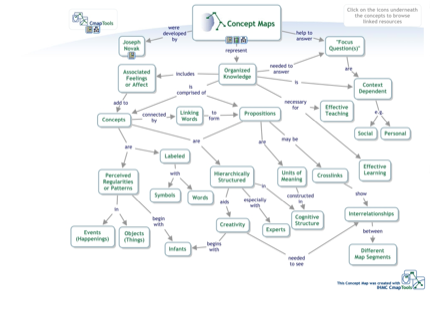
He also experimented with various forms of mind maps and concept maps. If you force students to name the link every time they connect two nodes, you force them to think about why. It's kind of annoying, but useful. The OU's Cohere does this.
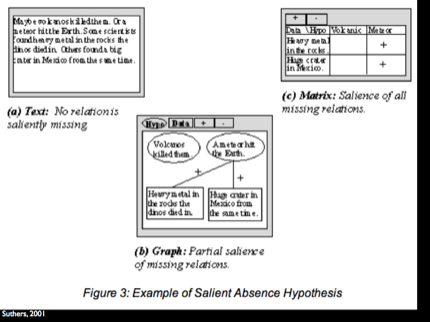
Artefact and discourse
One important function that the external representation plays in a group setting is as a shared referent for discussion. It is useful to distinguish between artifact and discourse, as two overlapping but different concepts. In a face-to-face meeting the distinction is very clear — an artefact is whatever is captured and shared between the participants, as opposed to the fleeting conversations that in most cases are not recorded at all. The artefact not only maintains the participants' current state of knowledge during the workshop, but also gets to represent the outcomes and the collective memory of the event.
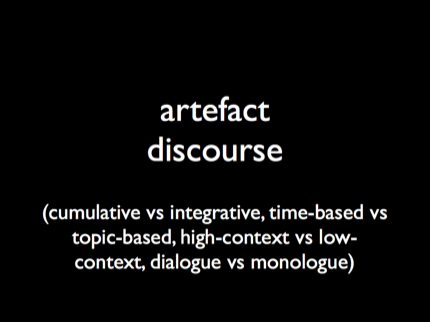
In an online environment, where everything is captured, the distinction becomes more blurry. But in most cases you can distinguish between discourse as more cumulative and artefact as more integrative. A threaded discussion forum is a good example of a discourse setting: each post contextually bound to chronology and to the post it replies to; the conversation moves inexorably forwards; not that interesting to go back to unless you want to trace how ideas developed. An integrative artefact is more like a wiki page — more independent of a specific context or time, which changes to always provide an up-to-date representation of the community's state of knowledge. Wikipedia captures this exactly: the article is the integrative artefact, and the Talk page, which features discussions about the article, is the discourse.
Deixis — how to point at things together
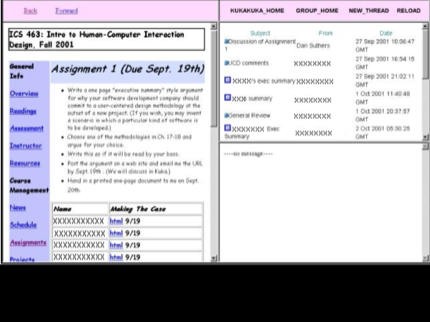
Suthers and his team have experimented with building collaborative learning platforms that integrate artefact-centric discourse (Dwyer and Suthers 2005; Lid and Suthers 2003; Suthers and Xu 2002). In addition to making sure both the artefact and the discourse are visible at the same time, they have explored the concept of deixis — how you can point to a specific point on the artefact, especially a graphical one.
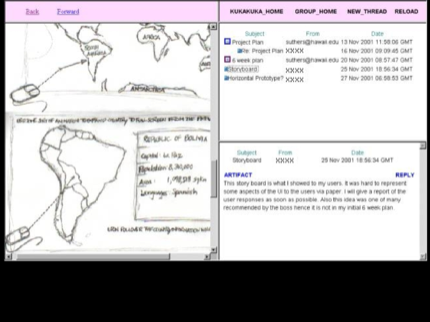
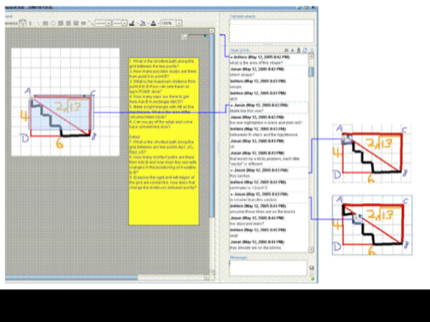
This is what students in Knowledge Building classrooms do when they meet for Knowledge Talk (Bereiter 2004). They have a big representation up on the screen, and they point to it: "What about this note — should it be connected to this other note?" But in an online setting, how can you effectively convey to other students what you mean by "this"?
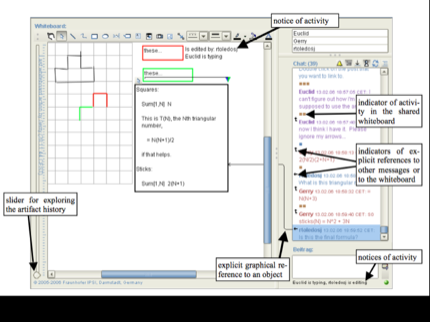
An example of attempting to overcome this problem is an environment developed at Drexel University called Math Forum (Stahl 2006). The tool provides a shared whiteboard where people work together on solving math problems, and a text chat on the right. For each message, they can point to something on the screen, and there is a line that connects the chat message to the area of the screen that the author is talking about. If you go back in time and click on a message that says "I think we should delete this", you immediately know what the person meant.
Manipulating ideas — divergence and convergence
Externalizing is only the first move. What happens to the ideas after they're out is where the settings differ most, and where the most interesting design space sits.
Stimulus / response
Stimulus/response describes a very typical way of organizing an online course. You have a forum each week; the teacher provides some stimulus — a reading, a recording, some new ideas. The students know that they have to participate, because of the participation marks and because people want to look good in front of the teacher, so they will contribute notes — any notes. Personal anecdotes, free association, whatever they can come up with that has anything at all to do with this topic.
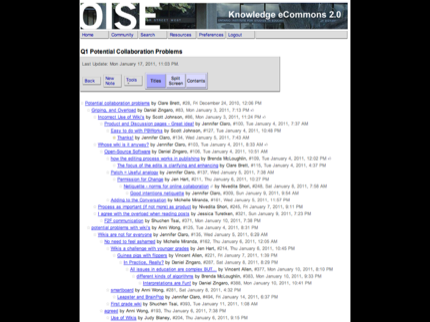
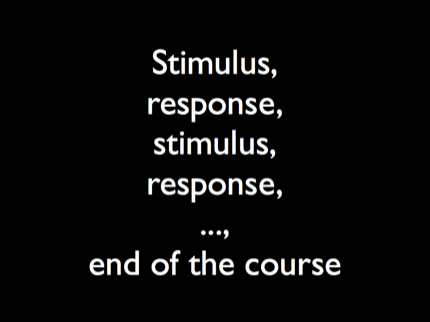
In a typical OISE course, many will have been teachers, so there might be many comments like "I remember when this happened in my class." There might be some scattered response, when people have new associations based on what their classmates posted, but it quickly dies down when people have "said what they had to say" — until some new stimulus is introduced. At the end of the course, what have the students gotten out of it? They have been exposed to some ideas, and they have heard some of their co-students' ideas. But this does not seem very ambitious for a graduate-level course. Likewise, Bereiter (2004, 254), discussing a group project where students gather information about polar bears, asks:
But what do they learn about polar bears from producing a multimedia document on polar bears? It all depends on what information they process in assembling the document. If the only questions they consider are "Is it about polar bears?" and "Does it look nice?" we may infer that not much polar bear knowledge will be acquired. — Bereiter (2004, 254)
Divergence / convergence
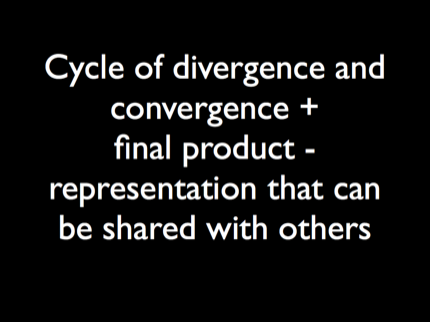
Another way of organizing a course can be described as a cycle of divergence and convergence. When diverging, we are brainstorming, freely associating, coming up with as many new ideas as possible, without being too critical about their utility or relevance. This is similar to the first five weeks of Scardamalia's course, where students were posting their responses to the initial stimuli; or the initial phase of the workshop, where people are creating sticky notes with ideas for topics to discuss.
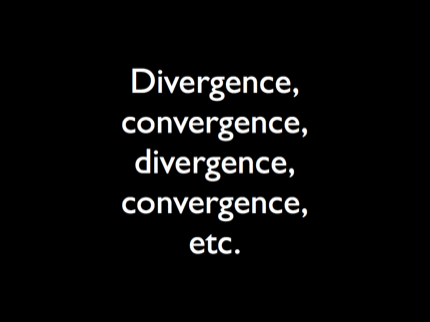
But a brainstorming that ends without doing anything with the produced material is not very valuable — and this is essentially another way of characterizing stimulus/response. What makes divergence/convergence different and more valuable is that after the participants have generated a large amount of material, they stop, take a step back, and begin to analyze what they have created. What are the emergent topics, groupings, connections that are forming? Once a topic has been named, we can dive back in and diverge again inside that named cluster. In many ways this is similar to a grounded-theory approach to qualitative research (see for example Kelle 1997).
Improvable ideas
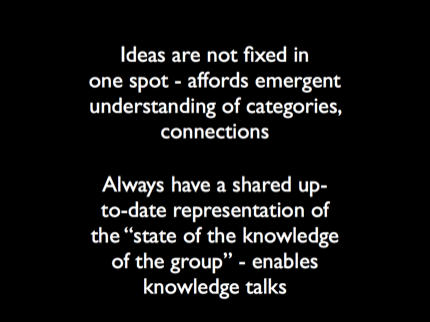
One of the core ideas of Knowledge Building is the improvability of ideas, where "participants work continuously to improve the quality, coherence, and utility of ideas" (Scardamalia 2002). One of the things I found so powerful about Knowledge Forum, with its spatial display, is that notes are not caught in the location where they were first posted. They can easily be moved and copied to other views — which is exactly what enabled the topical-views move in Scardamalia's class.
This is similar to the affordances of sticky notes at workshops — they can be moved around on the wall, and are very accessible to everyone, not just one person controlling a computer (Gunn 2008; Peterson and Barron 2007).
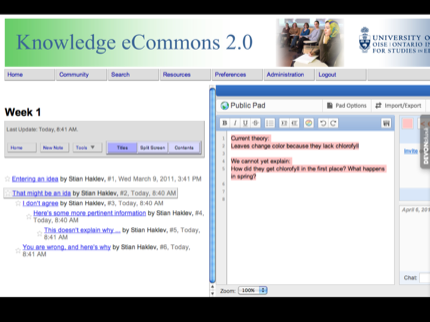
Although a spatial interface is very suited to this kind of knowledge work, we can imagine other interfaces implementing similar functionality. Knowledge eCommons is an application developed at OISE by Jim Hewitt that is purely textual. An experiment that has already been implemented is a split-screen view with a collaborative editing board (Etherpad) on the right, and the notes on the left. This is a classical integration between discourse and artefact — though currently there is no method for referring to a specific part of the artefact from the discourse.
One possibility for letting notes be more "moveable" would be to use tagging. In its folksonomy form — people tagging as they produce, without knowing which tags others have agreed on (Sinclair and Cardew-Hall 2008) — it works great in large communities like Twitter, but probably not in a small study group. Another approach is to hold off on tagging until certain categories have established themselves, and then use tags essentially as "global channels". When I tag a tweet with #ocwc2011, I know it will end up in the channel for people interested in the OpenCourseWare Consortium meeting (Hepp 2010). Students could go back to previous readings after a few weeks, find emergent topics, tag messages related to each topic, and have the system automatically create a new view which would contain all the tagged messages, plus a blank collaborative editing board for knowledge building around that topic.
Granularity of collaboration
An answer to the obvious objection: "but deep thinking can happen in lectures, or in solo blog posts, or anywhere — you're overfitting to your favourite tools."
Many would object to my description of collaborative software, and their ability to enable or not enable deep knowledge building — as well as the tying of thinking patterns (divergence/convergence vs. stimulus/response) to certain technological structures or physical workshop tools. As Downes (2011) argued in his defence of the traditional lecture, it is quite possible for deep engagement to be happening in the mind of someone sitting in a large lecture hall, receiving a lecture. And a committed student could certainly participate in a traditional discussion-forum-based online course, taking notes, creating concept maps, synthesizing, and then posting a new entry that brings together many threads and ideas.
To tackle this, I'd like to introduce the idea of different granularities of collaboration — how much of the working-with-ideas takes place in your own head, and at what point do you share your thoughts with others?
- Micro-collaboration. Two people who know each other well, engaged in a discussion about a problem, vocalizing every idea that comes through their mind, working together as one mind to solve the problem.
- Macro-collaboration. At the very far end of the scale: individual PhD researchers might read hundreds of books and articles, take thousands of pages of notes, diagrams, before they finally publish a dissertation that deals with decades' worth of literature. A few years after the dissertation, an article might appear that builds on its ideas; a few years later, another.
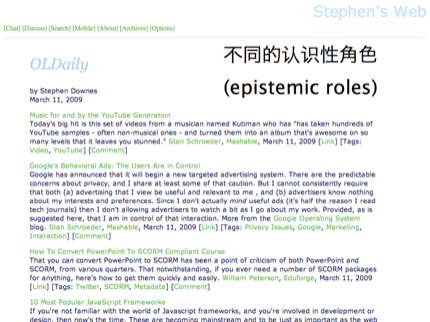
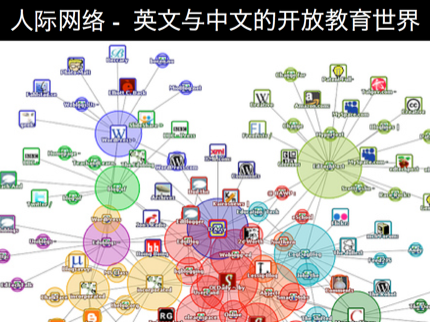
The PhD student might still be part of a local research team, and might exchange ideas with them at a much lower granularity. And in between these two poles there's a huge middle — edublogospheres, Twitter, mailing lists. I came up with this idea of people taking different epistemic roles in a network, where someone like Stephen Downes can be a "hub" reading everyone's blogs and pulling them together in a daily newsletter. I especially pointed that out in China, because there was nobody fulfilling a similar role in the Chinese edublogosphere, making it very hard for me as an outsider to orient myself.
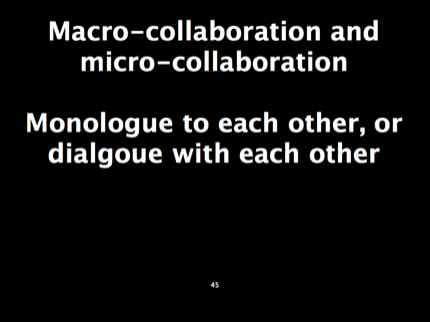
This distinction is useful because it covers many areas where we instinctively feel there is collaboration and knowledge building going on — such as the edublogosphere, where you can see a progression of ideas and a community understanding of the current state of knowledge — yet there are no affordances in the tools we use that make this knowledge building easier.
We can also experiment with lowering the granularity in fields where it has traditionally been quite high. An example is the movement for Open Notebook Science (Bradley 2007), where researchers who would traditionally hoard their lab results until the final paper was published are now voluntarily sharing their data in almost real time with anyone who might be interested.
What would a more connected Knowledge Forum look like?
I got together with Alexander McAuley, who works with Dave Cormier, to give a presentation about how it would look if Knowledge Forum were more integrated with the web. Two scenarios.
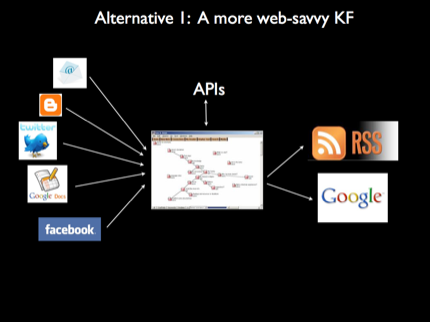
A. Still use Knowledge Forum as the organizational principle, but make it much more open to input and output: email to it, tweet to it, subscribe to RSS feeds, open APIs.
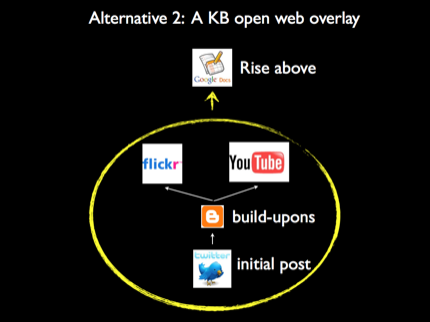
B. Maybe there is no space called "Knowledge Forum" that we go into — it's more of an overlay over the web. Diigo and the Harvesting Gradebook are examples: you go to someone's blog and grade the assignment right there. A browser overlay that allows you to make the process of dealing with many different information sources and ideas more systematic, and allows you to share knowledge representations with others.
Automating sensemaking
One more thread I pulled at in the talk — which never made it into the paper. When the corpus gets very large, can visualization do some of the converging for you?
Can different visualizations help automate some of the work, when the amount of information becomes so large that no human can cluster it by hand?
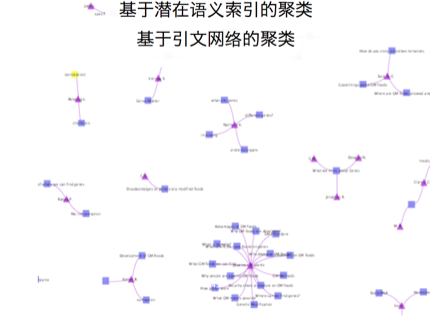
- Latent semantic analysis
- Social network analysis
- Citation analysis
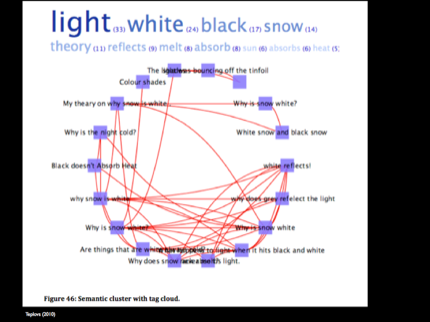
This is an interesting visualization that Christopher Teplovs created as part of his PhD thesis. He used latent semantic analysis to show clusters of ideas in a Knowledge Forum database, and then generated word clouds for each cluster, to quickly show what they were discussing — and how that changed over time. A way to do the grouping-and-naming step automatically, so that humans can jump straight to the dig-deeper step.
Conclusion
I began by positing that there were commonalities in the way we work with ideas individually, the way groups work with ideas in hybrid or online spaces, and in the way innovative approaches to workshops try to improve the knowledge building that happens with people collaborating in physical spaces.
I introduced three examples of these different settings, and discussed a number of analytical concepts, taken both from the literature and from my own experience. I mentioned the importance of externalization of ideas, which relates both to spatial organization and to salience of the medium for expressing the ideas, as well as the importance of knowing that the ideas are "safe" — which frees up energy to focus on a subset of the ideas by yanking them to the centre.
I then introduced two different idealized models of collaboration scripts in online classes, based on two examples that I personally experienced; discussed software support for improvable and movable ideas; and introduced the concept of granularity of collaboration to explain why knowledge building might also occur in environments that do not seem to support the concept of improvable ideas natively.
I believe this has demonstrated that there is fruitful terrain in exploring the intersections between individually working with ideas, group collaborative learning, and workshop methodologies (about which, unfortunately, there seems to be very little academic literature). It would be interesting to hear people active in facilitating collaborative courses reflect upon how they as individuals process information, and also on how workshops and conferences organized for people within Computer-Supported Collaborative Learning could better foster collaborative knowledge building.
So I certainly don't have a conclusion in the strongest sense — these are things I have been thinking about for a long time, and giving this talk helped me clarify and collect some of my thoughts. I hope to engage some of you in dialogue about these ideas going forward.
Eight years later — the same three levels, shifted
While republishing this page I went looking through an old Roam database and found a short note I had written after giving a talk at a Roam meetup. It is the same framework, still the spine of how I think about this — but the third level has shifted.
In the 2011 paper the three settings are: individually, an online/hybrid class, and a face-to-face workshop. Eight years later, writing in Roam around the time of the Building-a-Second-Brain wave, I kept the three-level structure but the middle and outer levels had migrated:
Three levels of note-taking / knowledge organizing in social contexts — from a Roam meetup talk, c. 2020.
- Individually — Building a Second Brain (Tiago Forte), Zettelkasten (Luhmann), etc.
- In small groups — Marlene Scardamalia and Knowledge Building / Knowledge Forum, a lot of CSCL in general, focused on use of wikis in classrooms, etc. Group cognition, shared epistemic responsibility. "What does the group know?"
- In networks — Michael Nielsen's Reinventing Discovery, George Siemens and Stephen Downes on Connectivism for learning networks.
But in addition — how does this interact with the design of artefacts?
- What does it mean for learning and teaching? A lot of texts about note-taking focus on individual students in a traditional system — but how would you redesign the actual education experience around students "building second brains"?
- What is the future of the non-fiction book? Compression and expansion / serialization. Link between note-taking and cognitive structures — what does it mean to have learnt something?
- The tension between designing for certain interactions and excluding / narrowing the space — links to over-scripting and fading scaffolding. Distributed cognition — some things it's OK to always leave outside ("digital prosthesis"). And still: Suthers and salience.
The bones are the same. Three scales — individual, small group, something bigger — with the same cross-cutting questions about externalization, salience, and how the tool shapes the thinking. What changed:
- The third level migrated from physical workshop (Allen Gunn's sticky-notes methodology) to networks (Nielsen's open science, the connectivist MOOC as a mass object of study rather than a host for the talk). The workshop move lives on inside the framework — it is still the cleanest image of divergence-then-convergence — but as a level of its own it was provincial. Networks were the level waiting behind it.
- The individual level picked up the PKM movement (Forte's BASB, the Zettelkasten revival) which did not exist as a named thing in 2011. The problem of "what do I do with 900 Kindle highlights?" became an industry.
- The small-group level stayed put. Knowledge Forum / CSCL is still the deepest answer I know of to "what does the group know?", and it is still mostly invisible to the PKM and the network-learning communities on either side of it.
- The real shift, though, is in the open question. In 2011 I was asking: what are the common principles across these settings? By 2020 I was asking the much harder question: what would it mean to redesign education and non-fiction writing around these principles? — i.e. not "can we describe the moves" but "can we build institutions that take them seriously."
I still don't have an answer to that. But it is why this page exists. The 2011 talk was a proposal for a vocabulary; the 2020 Roam note is what that vocabulary started asking for once I could see a decade further on.
References
Allen, D. 2001. Getting things done: The art of stress-free productivity. Penguin Group USA.
Bereiter, C. 2004. Education and mind in the knowledge age. British Journal of Educational Psychology 74: 127–38.
Bernstein, M. 2007. The Tinderbox Way. Eastgate Systems, Inc., USA.
Blair, Ann. 2010. Too Much to Know: Managing Scholarly Information before the Modern Age. Yale University Press.
Bradley, J. C. 2007. Open notebook science using blogs and wikis.
Buzan, T., and B. Buzan. 2006. The mind map book. Pearson Education.
Downes, Stephen. 2011. The Lecture Must Stand.
Dwyer, Nathan, and Daniel D. Suthers. 2005. A study of the foundations of artifact-mediated collaboration. Proceedings of CSCL '05: 135–44. doi:10.3115/1149293.1149311.
Gunn, Allen. 2008. Creating Participatory Events.
Hepp, M. 2010. HyperTwitter: collaborative knowledge engineering via twitter messages. Knowledge Engineering and Management by the Masses: 451–61.
Kelle, U. 1997. Theory building in qualitative research and computer programs for the management of textual data.
Lid, Viil, and Daniel D. Suthers. 2003. Supporting Online Learning with an Artifact-Centered Cross-Threaded Discussion Tool. Computers in Education.
Peterson, Elizabeth R., and Kevin A. Barron. 2007. How to Get Focus Groups Talking: New Ideas That Will Stick. International Journal of Qualitative Methods 6.
Scardamalia, Marlene. 2002. Collective cognitive responsibility for the advancement of knowledge. Liberal education in a knowledge society: 67–98.
——. 2003. Knowledge Forum (advances beyond CSILE). Journal of Distance Education 17: 23–28.
Sinclair, J., and M. Cardew-Hall. 2008. The folksonomy tag cloud: when is it useful? Journal of Information Science 34: 15.
Stahl, G. 2006. Group Cognition: Computer Support for Collaborative Knowledge Building. Cambridge, MA: MIT Press.
Suthers, D. D. 2008. Empirical studies of the value of conceptually explicit notations in collaborative learning. In Knowledge Cartography: Software tools and mapping techniques, ed. A. Okada, S. Buckingham Shum, and T. Sherborne, 1–23. Springer.
Suthers, Daniel D. 2001. Towards a Systematic Study of Representational Guidance for Collaborative Learning Discourse. Journal of Universal Computer Science 7: 1–24.
Suthers, Daniel, and Jun Xu. 2002. Kükäkükä: An Online Environment for Artifact-Centered Discourse. World Wide Web Internet And Web Information Systems: 472–80.